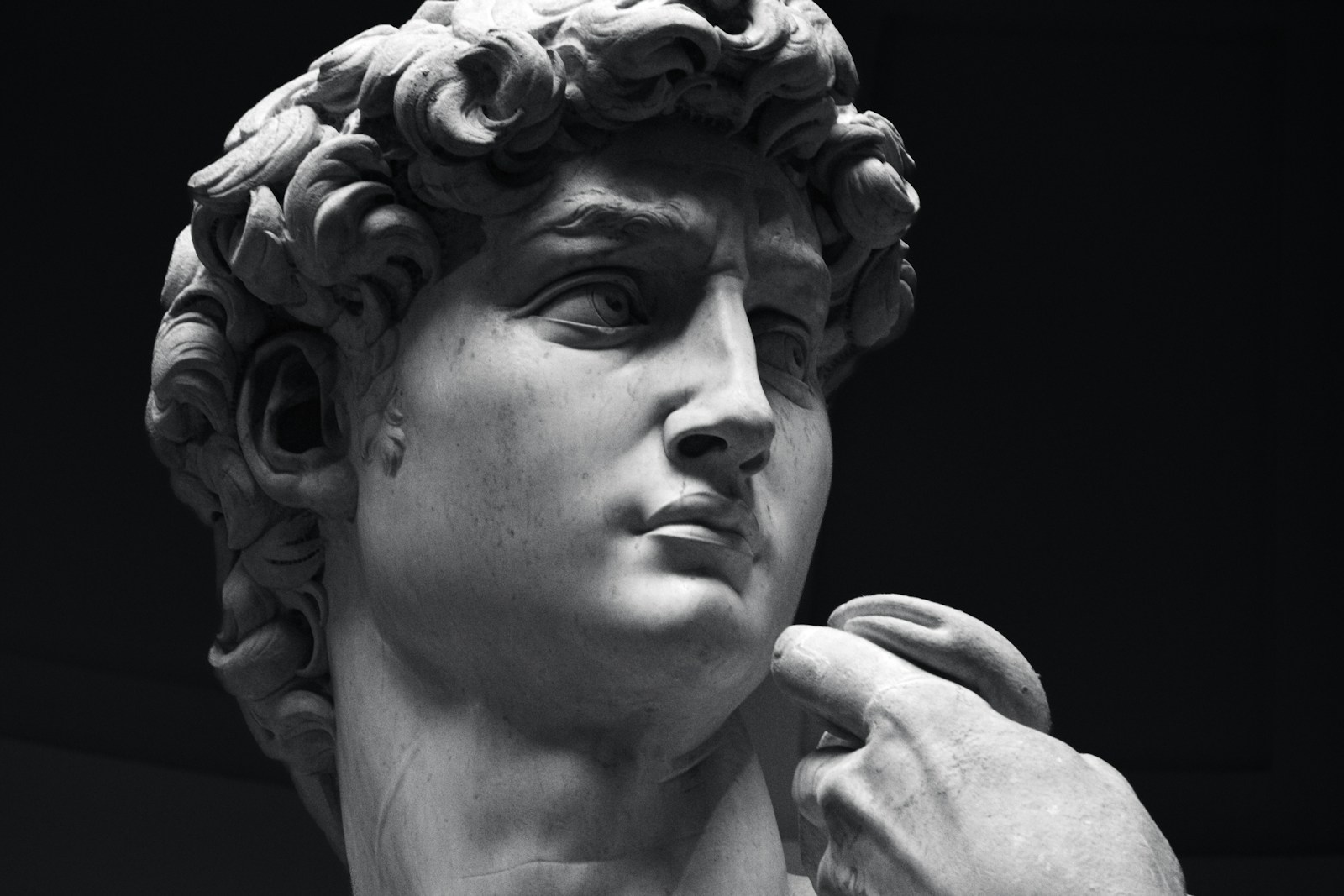
You think you know Michelangelo’s David, sixteen feet of marble confidence, the ultimate Renaissance flex. But the closer you look, the more this statue reveals: a recycled block with a past, engineering sleights of hand, optical tricks, and political bravado carved into every vein. If you’ve ever wondered how a flawed stone became the most famous sculpture on Earth, here’s your backstage pass to Michelangelo’s David: Secrets of the Marble Masterpiece.
From Abandoned Block To Renaissance Icon
A Flawed Marble And A Failed “Giants” Project
You’re not starting with perfection here. The block that became David was a problem child, an enormous, weather-beaten lump of Carrara marble, roughed out decades earlier for a doomed series of cathedral “giants.” Agostino di Duccio began hacking at it in the 1460s: Antonio Rossellino may have prodded it after. Then everyone walked away. The marble sat outdoors, pitted and narrow, its core laced with veins and a troubling shallow depth. Locals called it “the Giant,” but not kindly.
By 1501, Florence had the stone, and a headache. The Opera del Duomo wanted a hero on the cathedral buttresses, high above the city. They needed someone reckless or brilliant (preferably both) to rescue the block from its past. Michelangelo, 26 and already notorious for the Pietà, said yes.
Michelangelo’s Contract And Bold Vision
Your contract is simple: take the battered marble and deliver a colossal David. Michelangelo sealed the deal in August 1501 and moved the block into the cathedral yard under a makeshift shed. For nearly three years he worked in secrecy. The bold part? He scrapped the usual triumphant David-standing-on-Goliath trope and froze the story a heartbeat earlier, the tense moment before battle. No severed head, no gore. Just the human body turned into a loaded spring, a mind calculating odds, and a city’s ideals projected at monumental scale.
Carving Secrets: Tools, Methods, And Workshop Practices
Working Directly In Marble Without A Full-Scale Model
If you’re picturing a full-size clay figure copied point-for-point into stone, think again. Michelangelo preferred to “liberate” forms directly from marble, using small bozzetti (sketch models) and sharp eyes rather than a full-scale replica. He likely used calipers, plumb lines, and a grid of reference points scratched onto the block, but not the later pointing machines you see in 18th–19th century ateliers.
He roughed out with a subbia (point chisel) and mallet, riding the shock into the stone to remove heavy waste. Then came toothed chisels to shape volumes, flat chisels to sharpen transitions, and rasps to refine anatomy. He worked all around, keeping masses in balance, advancing the figure in layered passes so no area got too far ahead, an insurance policy against nasty surprises in the marble.
Chisel Marks, Polishing, And Surface Finishes
You can still read the choreography of tools. Hair and sling straps preserve crisp tooth marks: torsos and limbs move toward a satiny polish that catches light without going glass-smooth. He used abrasives like pumice and emery to tighten the skin and let highlights bloom on shoulders and knees. That mixed finish is intentional: matte passages soften forms: bright accents pull your eye. David’s sheen isn’t vanity, it’s optics.
Anatomy, Proportions, And Optical Corrections
Oversized Hands And Head For Elevated Viewing
Stand at ground level and the hands look a touch large, the head a shade big. That’s not a mistake: it’s an optical correction. David was first conceived for a high cathedral perch, so Michelangelo boosted features that would otherwise shrink in perspective. The right hand is a manifesto, veins taut, tendons alive, because that’s where the story (and your eye) lands.
The proportions follow a living, breathing logic more than a geometric schema. Muscles don’t just show: they function. You feel weight shift into the right leg: the left leg relaxes. The torso rotates subtly, shoulders counter the hips, and every plane change collects light like a carefully aimed reflector.
The Gaze, Veins, And Tension Before The Battle
Look at the eyes. They’re slightly asymmetrical, with drilled pupils and incised irises that sharpen the gaze. He’s sighting a target you can’t see, jaw set but not clenched, more calculation than rage. The veins running over the right hand and forearm are puffed with anticipation, not afterglow. By choosing the pre-battle instant, Michelangelo invites you into a mind-body loop: strategy in the eyes, outcome in the tendons, courage in the stance.
Engineering The Impossible: Structure And Stability
Hidden Supports: The Trunk And Sling
Marble is strong in compression but brittle in tension, and David asks a lot from a vulnerable material, thin ankles, extended arms, a heavy head. Michelangelo sneaks in support with classical flair: the tree trunk behind the right leg buttresses the weight-bearing limb, and the strap of the sling adds a diagonal marble bridge. These aren’t decorative afterthoughts: they’re structural lifelines dressed as narrative details.
The contrapposto is also an engineering strategy. By loading the right leg and letting the left relax, he keeps the statue’s center of mass stacked over the base. The twist distributes stresses along robust zones of the torso rather than daring fate across fragile spans.
Reading The Marble’s Grain And Risk Management
You can’t bully marble. The block Michelangelo inherited was narrow and veined, with internal flaws. He “read” the stone, following grain directions, avoiding weak planes, and leaving extra mass where risk ran high (ankles, wrists, neck). Tool blows were angled to push forces into the block rather than pry it apart.
Even with genius planning, time takes its cut. Microfractures at the ankles, documented in modern studies, remind you how close this miracle runs to catastrophe. The base and support systems have been strengthened in recent decades to hedge against vibration and seismic risk. Engineering never left: it just went undercover.
Symbolism, Politics, And Public Reception
Placement In Piazza Della Signoria And Civic Meaning
In 1504, a committee that included Leonardo da Vinci and Botticelli debated where to place the statue. They chose the political bullseye: outside the Palazzo Vecchio, seat of government. Overnight David became the city’s self-portrait, Florence as the quick-witted underdog facing hulking powers. Nudity reads as classical virtue and moral clarity, not scandal: the sling becomes a citizen’s tool, not a king’s weapon. He faced outward as a warning: we’re small, but don’t mistake us for weak.
Crowds loved him. “Il Gigante” wasn’t just beautiful: he was useful propaganda. The figure’s calm control, no trophy at his feet, felt like a republic’s ideal of measured strength.
Debates, Damage, And The Statue’s Resilience
Public art lives a rough life. In 1527, during a political uprising, stones hurled in the piazza shattered David’s left arm: fragments were carefully collected and restored. Centuries of weather sanded details and deepened cracks. In 1991, a vandal attacked the left foot with a hammer, chipping toes and sending conservators into triage mode. Each incident sparked debates: How close should viewers get? How much should you polish, patch, or leave alone? Through it all, the statue’s authority never flinched, if anything, the scars underline his survival.
Conservation, Replicas, And Seeing David Today
Nineteenth-Century Casts And Global Copies
Before Instagram, the 19th-century had plaster casts. Museums from London to St. Petersburg installed full-scale Davids so students could study the form without crossing borders. Florence itself commissioned a bronze replica for Piazzale Michelangelo in the 1870s, and a marble copy now guards the original piazza site. These replicas shaped modern taste, and, frankly, saved the original from some wear and tear.
Digital tech kept the tradition going. High-resolution scans in the late 1990s mapped every dimple and tool mark, aiding research and providing a baseline for monitoring changes. Today, you can encounter David in VR classrooms and high-fidelity 3D prints, but nothing replaces the shock of the real.
The 1873 Move Indoors And Ongoing Preservation
In 1873, Florence moved David indoors to the Galleria dell’Accademia to stop the weather from doing what invaders couldn’t. Controlled light, stable humidity, and a reinforced base now buffer the statue against the slow violence of time. Cleaning campaigns have aimed for restraint, lifting grime while respecting Michelangelo’s toolwork and that delicate not-too-glossy finish.
If you’re planning a visit, a few tips help you see the masterpiece as Michelangelo intended:
- Walk the long axis of the gallery first: the approach ramps up the drama as the figure resolves from silhouette to flesh.
- Circle slowly and dip down near the right leg to catch how the trunk and sling quietly shoulder the load.
Replicas still matter. The piazza copy lets you read David in the civic theater he once commanded, under open sky, with the palace at his back. Think of it as context you can’t quite pack into a museum.
Conclusion
When you stand before Michelangelo’s David, you’re not just seeing a perfect body, you’re reading choices. A discarded block becomes a manifesto: workshop craft turns into optical magic: structural tricks masquerade as storytelling. The statue’s power comes from the friction between fragility and control, public symbol and private study of the human machine. If you bring one secret home, make it this: Michelangelo didn’t merely carve a hero out of stone. He engineered a living argument, about courage, intelligence, and the audacity to turn limitations into legend. That’s the real heart of Michelangelo’s David: Secrets of the Marble Masterpiece.
No responses yet