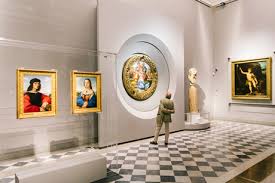
You step into the Uffizi and the air changes, light skims across marble, hushed footsteps echo, and frame after frame rewrites how you see beauty. Inside the Uffizi, you’re not just gallery-hopping: you’re moving through the DNA of Western art, from Giotto’s solemn calm to Caravaggio’s shock of realism. With so much to take in (and a few strategic choices), you can build a route that hits the icons without losing the joy of discovery. Here’s how to navigate, what to look for, and which must-see works deserve your time.
Navigating The Uffizi And Planning Your Route
Third-Floor Start And The Botticelli Rooms
You’ll begin at the top. The Uffizi’s main route starts on the upper level (third floor by elevator), where the long U-shaped corridor leads you past gilded altarpieces, Roman busts, and windows that frame the Arno and Ponte Vecchio. Don’t rush these corridors, those “view breaks” reset your eyes and help you avoid museum fatigue.
Early on, you’ll reach the Botticelli rooms, where crowds thicken for good reason. This is where you’ll see the mythic canvases that practically define the Uffizi. Plan to linger here: the scale and detail reward slow looking. If you’re pressed for time, mark this as a non-negotiable stop, then relax knowing you’ve seen the heart of the collection.
Timing, Tickets, And Crowd Strategy
The Uffizi is wildly popular year-round, so a little planning buys you a lot of peace. Reserve a timed-entry ticket in advance, don’t rely on the door line. Morning slots right at opening or late afternoons are calmer, especially midweek. Avoid the first Sunday of the month when Italian state museums are free and lines surge.
- Book a skip-the-line timed ticket via the official Uffizi site, arrive 15–20 minutes early for security, and travel light (large bags go to cloakroom: no flash photography).
If you can, go off-season (November–March), or choose shoulder times even in summer. And build in a short break at the café terrace above the loggia, the view over Palazzo Vecchio is a reward in itself.
90-Minute Versus 3-Hour Plans
If you have 90 minutes, stay disciplined. Start upstairs, go straight to Botticelli, then backfill two or three anchors: Giotto’s Ognissanti Madonna, Leonardo’s Annunciation, and Michelangelo’s Doni Tondo when you descend. Add one Baroque knockout, Caravaggio’s Medusa, on your way out. You’ll leave satisfied, not frazzled.
With three hours, you can breathe. Keep Botticelli as a highlight, but widen your lens: absorb the Early Renaissance room trio (Giotto, Piero della Francesca, Uccello), the High Renaissance set (Leonardo, Michelangelo, Raphael), then swing through the Venetian and Mannerist rooms (Titian, Parmigianino, Bronzino). Finish with Caravaggio and Artemisia Gentileschi for a dramatic last act. Use corridor windows for quick resets: peek toward the Vasari Corridor from the river-facing side for a sense of the Medici’s elevated passageway across the city.
Early Renaissance Cornerstones
Giotto’s Ognissanti Madonna
Stand back and let the throne rise like architecture. Giotto takes the gold-ground tradition and anchors it in weight and volume, Virgin and Child as bodies, angels stacked in space, not just pattern. You’re watching painting wake up to gravity and presence, a century before the word “Renaissance” is even coined.
Piero Della Francesca’s Duke And Duchess Of Urbino
This double portrait is cool as morning light. In strict profile, Federico da Montefeltro and Battista Sforza face each other across a landscape that feels infinite. Look closely: the aerial perspective steps the hills back in a haze, while the sitters remain crisp, almost sculptural. It’s the marriage of math and poetry, a quiet summit of 15th-century intellect.
Uccello’s Battle Of San Romano
All glitter and geometry, Uccello’s soldiers clash like chess pieces. Lances become vanishing lines: broken staves are rulers strewn across a stage. It’s action you can measure, a battle suspended between fairy tale and diagram. The Uffizi’s panel is one of three (the others live in London and Paris), and this one pops with the burnish of armor and orange orchards, war as spectacle, meticulously plotted.
Botticelli’s Mythic Visions
The Birth Of Venus
You know the image, but seeing it in person recalibrates it. Venus isn’t storming the beach: she’s floating, poised, almost listening. Botticelli’s line is everything: the fluttering hair, the scallop shell’s curve, the embroidered cloak ready to envelop her. Watch how the pale greens and rose tones keep the scene dream-bright rather than sunlit. It’s a pagan myth painted with the elegance of a courtly dance.
Primavera
This is a garden you decode, not a single scene you “get.” Mercury flicks away clouds on the left: the Three Graces turn in translucent drapery: Flora scatters flowers: Zephyrus chases Chloris into transformation. And in the center, Venus presides with a calm that stitches the story together. Let your eyes drift and pick one thread at a time, the longer you look, the more the painting rearranges itself around you.
The High Renaissance Triumvirate
Leonardo’s Annunciation And Adoration Of The Magi
Leonardo’s Annunciation is a masterclass in attention. The angel’s wings, botanically curious plants, the perspective of the marble table, it’s all measured, but it breathes. The seaside distance feels humid and real. Nearby, the unfinished Adoration of the Magi shows Leonardo thinking on the panel: underdrawings, swirling figures, and a pyramidal structure forming in raw umber. You’re seeing draft and destiny at once.
Michelangelo’s Doni Tondo
Michelangelo almost makes paint sculptural here. The Holy Family twists in a spiral, bodies modeled like marble, colors saturated to near-neon. The circular panel pulls your gaze inward and around while the nudes in the background hint at the artist’s obsession with the ideal body. It’s a hinge between the serene harmony of the High Renaissance and the restless energy that follows.
Raphael’s Madonna Of The Goldfinch
Raphael answers intensity with grace. The triangular grouping, the soft Tuscan landscape, the tiny goldfinch (a symbol of the Passion) cradled by the Christ child, it’s serenity without sugar. After a careful restoration, the colors sing again, and Raphael’s unshowy perfection feels like exhale after Michelangelo’s flex.
Venetian Color And Mannerist Grace
Titian’s Venus Of Urbino
This isn’t myth at a distance: it’s intimacy up close. Titian’s Venus meets your gaze as if you’ve just entered the room. Flesh is painted like living light, bed linens a symphony of whites, background maids anchoring the domestic world. Color does the storytelling here, proving why Venice’s painters were called colorists with almost religious fervor.
Parmigianino’s Madonna With The Long Neck
Elongation becomes elegance. The Virgin’s swanlike neck, the porcelain skin, the column that climbs out of scale, it all tilts reality toward style. Mannerism isn’t a mistake: it’s a choice to heighten beauty by bending it. Step closer and the brushwork softens edges into a lacquered dream.
Bronzino’s Eleonora Of Toledo
Power can be quiet. Eleonora sits immaculate in brocade that steals the show, every thread painted like a tiny relief. But look at the stillness in her face and the small child at her side. Bronzino’s cool, enamel-like finish tells you this is court portraiture at its sharpest: identity polished to gleam, influence cloaked in silk.
Baroque Drama And Northern Voices
Caravaggio’s Medusa And Bacchus
Caravaggio’s painted shield of Medusa is a jolt, the moment of beheading frozen with a scream so real you almost hear the breath. Light scythes through darkness: blood flicks outward: it’s theater you can’t look away from. Contrast that with his youthful Bacchus: wine, fruit, a teasing invitation. Yet look again, the leaves wilt, the skin flushes imperfectly. Beauty here is mortal, and time is the co-star.
Artemisia Gentileschi’s Judith Slaying Holofernes
There’s no coyness in Artemisia’s version. Judith and her maid are all muscle and focus, sleeves rolled, blood arcing. The composition pins you to the action, and the lighting is ruthless. Knowing Artemisia’s biography adds layers, but even without it you feel the force of a painter claiming the Baroque’s most dramatic language and speaking it fluently.
Rembrandt’s Self-Portrait
Across the Alps, Rembrandt turns the drama inward. His self-portrait is a conversation with age, craft, and light. Watch how the face emerges from darkness in strokes that feel both careful and spontaneous. The eyes are doing the talking, worldly, a touch weary, unblinking. It’s a fitting counterpoint to Italy’s fireworks: introspection as spectacle.
Conclusion
Inside the Uffizi, you’re walking a relay, each century handing the baton to the next with a new way to see. Build your route, claim your quiet moments, and let a handful of masterpieces anchor the rest. If you plan smart (timed ticket, early start, a pause at the windows), you can have both the greatest hits and the surprises in the margins. And when you step back onto the Lungarno, Florence won’t look quite the same. That’s the point.
No responses yet