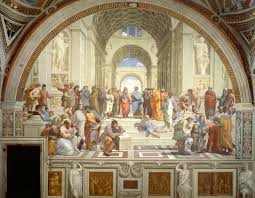
You don’t stand before Raphael’s The School of Athens so much as you enter it. Your eye is pulled through an idealized hall toward a cool blaze of light, where Plato and Aristotle hold court as if time folded to let every great mind gather at once. If you’ve ever wondered why this fresco feels so inevitable, so right, it’s because every stone, gesture, and prop is arguing something. You’re not only looking at a masterpiece: you’re stepping into a visual thesis on how knowledge works, why humanism mattered in Renaissance Rome, and how a painter could turn philosophy into spectacle.
Setting the Stage: Raphael, Rome, And the Stanza Della Segnatura
Purpose of the Room
When you walk into the Stanza della Segnatura, Pope Julius II’s private library and signing chamber in the Vatican, you’re inside a program, not just a pretty room. The four walls map the realms of knowledge: Theology (La Disputa), Poetry (Parnassus), Philosophy (The School of Athens), and Law (the Cardinal and Theological Virtues with scenes of Justice). You’re meant to feel the harmony between sacred truth and human inquiry: revelation on one wall, reason on the opposite, the imagination and jurisprudence completing the circle.
The School of Athens claims the wall of Philosophy. It argues that rational investigation, the best of Greece, belongs inside the papal apartments because truth is one. Raphael, barely in his late twenties around 1509–1511, stages the fresco as a living library where ideas meet in public.
Patronage and Workshop Practice
Pope Julius II didn’t just want decoration: he wanted a legacy. His patronage, driven by power, piety, and a competitive Rome, put Raphael alongside Bramante and Michelangelo. Raphael’s workshop, large and well-drilled, handled strenuous fresco cycles: cartoon drawings transferred to wet plaster, rhythmic division of wall into giornate (daily sections), and assistants executing passages under the master’s design. You’re seeing a team sport led by a captain who understood clarity. Figures are individualized yet legible from across the room. The method is technical, but the effect feels effortless: a chorus tuned by a single ear.
Architecture as Argument: Composition, Perspective, And Space
Central Axis and Vanishing Point
The perspective does the first persuading. The vanishing point, right between Plato and Aristotle, anchors the entire space. You’re dragged toward dialogue, not dogma. Orthogonals in the marble floor and the grand coffers of the vaults guide your gaze forward, then up. The composition is a perfect cross of horizontal bands (the steps and crowd) and verticals (columns and statues), stabilizing a teeming scene. Raphael builds a stage where complexity reads as clarity.
Statues and Architectural Allusions
The hall’s sober grandeur nods to Bramante’s designs for the new St. Peter’s, hemispherical domes, monumental piers, clean geometry. The gods preside: Apollo (with lyre) and Athena/Minerva (with helmet and aegis) occupy niches, blessing the union of reason, music, and prudent war, disciplines of the mind. You’re inside a church of wisdom, where pagan form and Christian purpose don’t clash: they align. The architecture isn’t background: it’s the thesis that order in space mirrors order in thought.
Plato and Aristotle at the Core: Dual Visions of Truth
Gestures, Books, and Color
At the center, Plato and Aristotle stride forward like twin poles of a magnet. Plato points upward, holding the Timaeus: Aristotle extends his right hand, palm down, with the Nicomachean Ethics. It’s a brilliant shortcut: ideas in gesture. Plato’s red-purple robe hints at fire and ether: Aristotle’s earthier blue and brown ground him. You can almost hear the argument, eternal forms versus empirical moderation, without a word.
Reconciling Ideals and Experience
Raphael doesn’t force you to choose sides. He suggests a reconciliation: the vanishing point sits between the two, and the crowd around them includes thinkers who measure, debate, sing, and legislate. The center is dialogue itself. You’re meant to take away a humanist ideal, the highest truth is approached through a balance of ideals and experience, metaphysics and ethics, theory and application.
The Cast of Thinkers: Identities, Portraits, And Meanings
Mathematicians and the Measure of Reality
On the lower left, Pythagoras drafts ratios while an attendant holds a tablet showing harmonic intervals. Across the front steps, a man bends with a compass to teach geometry, commonly identified as Euclid but bearing the features of Bramante, a sly nod to architecture as applied math. Nearby stand figures with globes: Ptolemy, his back to you with the terrestrial sphere, and Zoroaster (often read as such) with the celestial sphere. Raphael himself slips in among them, glancing out at you, an artist claiming a seat at the table of knowledge.
A brooding Heraclitus sits alone on the steps, leaning on a block, chiseled features echoing Michelangelo’s visage, a respectful rivalry turned into character study. Diogenes lounges carelessly, scroll ajar, the anti-ceremonial skeptic in the most ceremonial of spaces. These aren’t mere cameos: they’re arguments about methods, calculation, observation, introspection, and dissent.
Ethicists, Dialecticians, and Civic Debate
The right half buzzes with rhetoricians and ethicists shaped for civic life. The tradition of dialectic unfurls in clusters of debate, faces turned, hands slicing the air. An Epicurus-like figure, crowned with vine leaves, suggests pleasure disciplined by reason. The placement implies that the city’s health depends on trained speech as much as on theorem. Raphael shows you a republic of minds, where persuasion, ethical, measured, public, has a home.
Decoding the Details: Gestures, Instruments, And Symbolic Props
Instruments of Inquiry
Objects here don’t clutter: they speak. A compass opens the geometry of the world: slates and tablets fix knowledge: the globes split cosmos and earth: the lyre under Apollo tunes number to music: scrolls tie antiquity to living debate. When you follow the props, you follow the argument from abstraction to application.
- Globes (celestial and terrestrial): mapping heaven and earth as complementary domains
- Compass, tablets, and slates: the surgical tools of proof and teaching
Costumes, Postures, and Personality
Raphael blends antique togas with Renaissance dress so you feel continuity, not costume drama. Philosophers wear sandals and drape: contemporaries sport fitted caps and rich fabrics. Posture is psychology: Plato strides and points: Aristotle mediates: Diogenes sprawls: Heraclitus sinks into thought: Euclid crouches to demonstrate. Even footwear matters, sandals for the timeless, boots for the contemporary, quietly bridging ages. And then there’s Raphael’s own self-portrait, looking out. It’s a signature and a thesis: painting, too, is a way of thinking.
Humanism in Action: Papal Program, Politics, And Synthesis
Harmony With Theology, Poetry, and Law
You can’t read The School of Athens without glancing around the room. Across from Philosophy, the Disputa stages theology with a Eucharistic center: to one side, Parnassus convenes poets under Apollo: to the other, Justice balances canonical and civil law beneath the cardinal virtues. Together, the four walls say what a Renaissance pope wanted you to believe: truth is coherent. Reason doesn’t oppose revelation: it prepares you to meet it. Poetry doesn’t distract from law: it enlarges the civic imagination. Raphael’s fresco is a hinge in this system, pivoting between divine mystery and human measure.
Visual Diplomacy for Julius II
This was also politics, polished and grand. Julius II needed an image of Rome as heir to antiquity and guardian of Christendom. By installing Plato and Aristotle in his library, he performs a diplomatic feat: reconciling pagan genius with Christian sovereignty. The architecture evokes the new St. Peter’s, linking ancient wisdom to papal building. Portrait allusions, Bramante as Euclid, Michelangelo as Heraclitus, fold contemporary rivals into a single Roman project. You’re meant to see unity where history had fissures. It’s more than a fresco: it’s statecraft in lime and pigment.
Conclusion
If you’ve ever tried to explain why The School of Athens still feels modern, here’s the simple version: it turns knowledge into a public space you can walk through. You’re guided to the middle where disagreement isn’t a problem but a process. Gesture becomes logic. Architecture becomes ethics. And art becomes the place where theology, poetry, law, and philosophy stop arguing and start harmonizing.
When you revisit the fresco, whether in person or on a screen, let your eye travel the tools, the shoes, the glances. Ask which figure you’d join for a minute and why. That’s Raphael’s quiet challenge: to take your place among the thinkers, not as a spectator, but as someone whose next question belongs on those steps.
No responses yet